By 5 Alone Threads
Revelation 19:16 declares the complete authority of Jesus Christ: He is King of kings and Lord of lords. Every earthly ruler and every power that opposes Him stands beneath His rule. The verse belongs to John’s vision of the victorious Christ, whose judgment is righteous and whose victory is certain.
“Jesus is King” can be easy to say. This passage helps us understand the weight of that confession. It calls us to trust Him, worship Him and follow Him with lives that reflect His character. Our hope rests in the King Himself, even when the world feels loud and unsettled.
“And he hath on his vesture and on his thigh a name written, KING OF KINGS, AND LORD OF LORDS.”
Revelation 19:16, KJV
Revelation 19:16 in context: the victorious rider
Revelation 19 begins with worship in heaven. God is praised for His righteous judgment, and the marriage supper of the Lamb is announced. The chapter then turns to a vision of heaven opened and a rider on a white horse.
In verses 11 through 16, the rider is called Faithful and True. He judges in righteousness. He wears many crowns, and His name is called the Word of God. These descriptions lead us to Jesus Christ. Verse 16 makes His supremacy unmistakable: He bears the title King of kings and Lord of lords.
The surrounding verses also keep the picture from becoming a vague message about feeling powerful. Christ confronts evil and judges it. By the end of the chapter, the powers gathered against Him cannot stand. The vision directs attention to His holiness, His authority and the certainty of His victory. Revelation 19:11 through 21 in the KJV gives the surrounding vision.
A King above every earthly power
“King of kings” means that the greatest rulers are still beneath Him. “Lord of lords” declares an authority no rival can overturn. The title reaches beyond a particular nation, generation or political moment.
That matters when visible power seems final. A leader can demand loyalty. A culture can pressure people to be silent about Christ. Evil can appear secure. Revelation gives believers a larger view: none of those powers can take His throne.
John’s description also tells us what kind of King He is. He is Faithful and True, and His judgment is righteous. Human power can be used selfishly, dishonestly or cruelly. Christ’s authority is exercised in perfect righteousness. We can trust Him with the judgment that belongs to Him.
This confession also exposes the limits of attaching His name to our own ambitions. Jesus does not belong to a political brand or serve as an endorsement for everything we prefer. Our loyalties, words and choices come under His rule. To say that Jesus is King is also to say that we must listen to Him.
The victorious King is the Savior who gave Himself
Revelation’s picture of victory belongs with the rest of Scripture’s witness to Jesus. Philippians 2:5 through 11 speaks of His humility, His obedience to death on the cross, and His exaltation. The One confessed as Lord is the One who humbled Himself for sinners.
That keeps Christian confidence close to the gospel. We do not earn a place with the King by wearing the right words or presenting a strong image. We come to Christ as people who need His mercy. His glory gives us reason to worship; His saving work gives us reason to draw near.
It also shapes the way we understand strength. When Jesus spoke to Pilate in John 18:36 through 37, He said His kingdom was not of this world. His servants were not to establish it by fighting to prevent His arrest. Revelation’s vision describes His judgment; it does not authorize personal threats or vengeance.
Our calling is to belong to Him faithfully. The victory is His. So is the right to judge. We can speak truth with courage while treating the people in front of us with patience and care.
Living under His rule with courage and humility
Worship surrounds this vision in Revelation 19. Christ’s authority is worthy of trust and allegiance, and the chapter connects His righteous reign with the praise of heaven. Prayer, gratitude and obedience belong with that confession.
Allegiance to Christ also has an ordinary, visible expression. Truthfulness, acknowledging a wrong, keeping a promise and serving someone who cannot repay us can reflect the character of the King. The confession concerns everyday faithfulness as well as the words we use.
Confidence in the King belongs with Romans 1:16 and being unashamed of the gospel. The news is worth sharing because salvation is found in Christ, not because we can force someone to receive it.
Courage and a considerate manner belong together. In Matthew 10:16, Jesus calls His people to wisdom and innocence. Being secure in His rule gives us room to listen, answer honestly and leave the outcome with Him.
The verse also offers hope when justice seems delayed. Revelation does not call evil harmless or promise that following Jesus will always be easy. It shows that evil will not have the final word. The King who judges righteously can be trusted while His people wait.
The Scripture behind Jesus is King
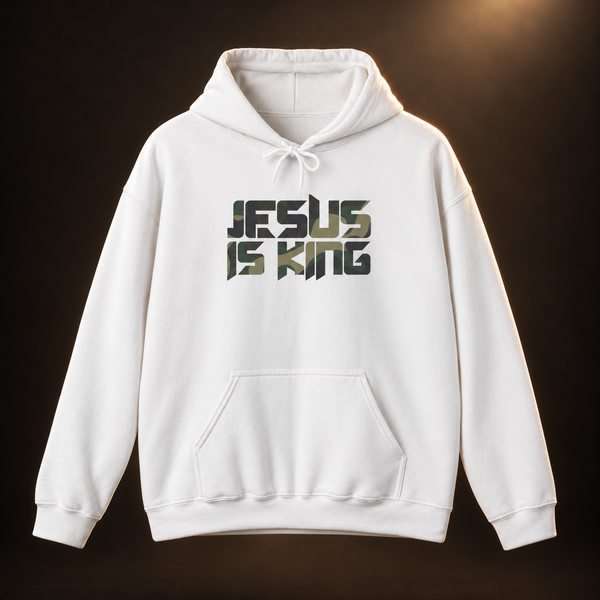
The Camo Jesus is King tee and Camo Jesus is King hoodie carry a confession rooted in Revelation 19:16. The artwork can serve as a reminder of whose authority lasts and whose character should shape our own.
Questions about the words can open a conversation about the passage. One simple explanation is: “It points to Revelation 19:16, where Jesus is named King of kings and Lord of lords.” The design connects that confession with the hope of His righteous rule.
The whole vision in Revelation 19 brings worship, righteousness and Christ’s supremacy together. Every earthly ruler stands beneath the King of kings. The words “Jesus is King” point beyond a design to the One whose authority endures and whose gracious rule gives His people hope.
Scripture quotations are from the King James Version (KJV). Main passage: Revelation 19. Supporting passages: Philippians 2:5 through 11 and John 18:36 through 37.